



FIRENZE: ARTE E CULTURA
di Angela Berti
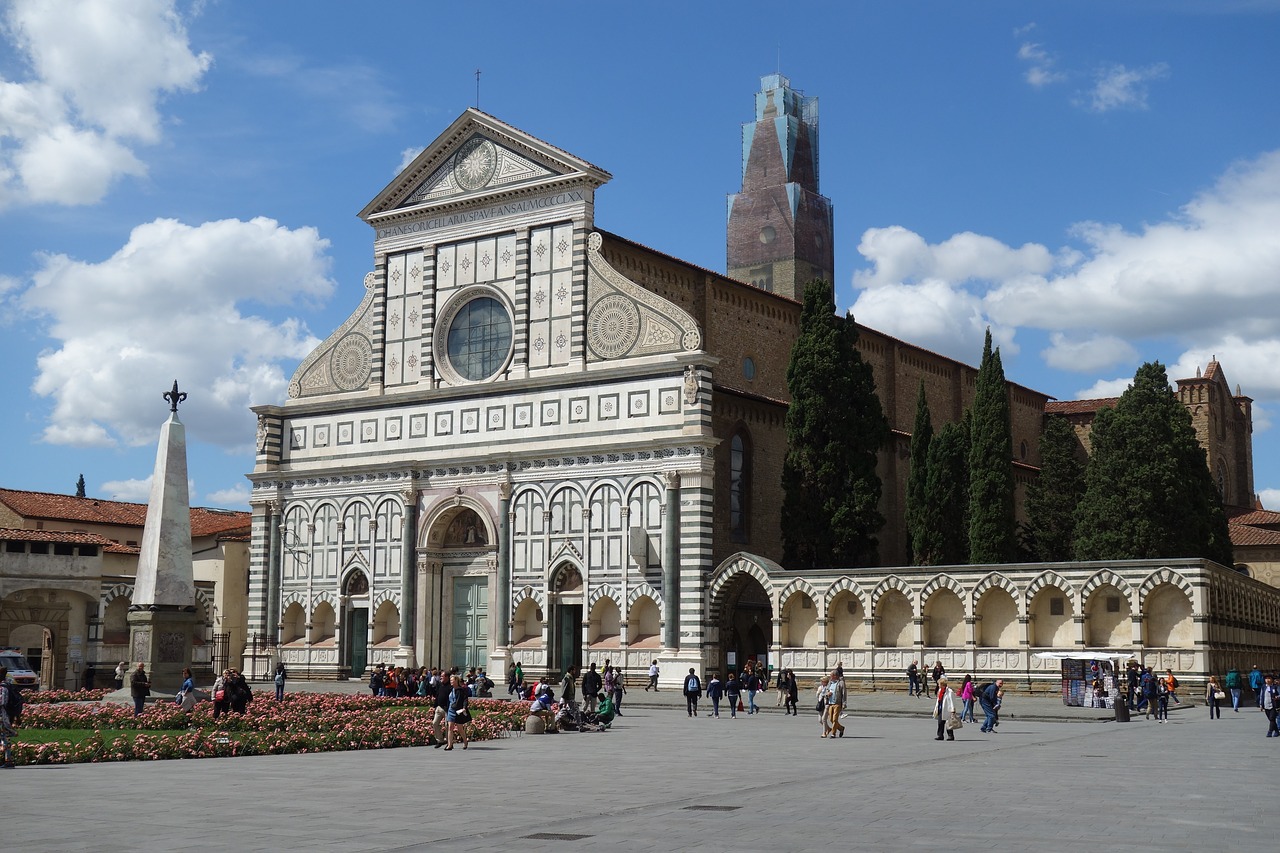
Santa Maria Novella is chronologically the first of the great Florentine basilicas. Its name, “Novella”, comes from the fact that it was built on the site of a 9th century oratory, called Santa Maria delle Vigne, which had already been enlarged in 1094. In 1221 this church and the surrounding area was assigned to the Dominican monks, who immediately began to transform it. Construction started on what were to be the sumptuous headquarters of the powerful Dominican Order in 1246; designed by two architect monks, Fra Sisto Fiorentino and Fra Ristoro da Campi, it was completed in 1360 under the direction of Fra Iacopo Talenti, who also designed the Spanish Chapel or chapter house (1350-55), the convent Refectory (1353) and the great pointed belltower in Romanesque-Gothic style (1330). The elaborate façade of inlaid black and white marble is a real masterpiece: it was started in 1300 and later completed by Leon Battista Alberti in 1470 and it can perhaps be considered to be the most beautiful of all the Florentine churches. Alberti harmoniously integrated the already existing mediaeval elements by developing them along a classical design, adding a triangular tympanum, as well as creating the two beautifully inlaid lateral volute or scrolls to hide the slope of the roof that covers the side naves. The interior of the Basilica is built on a Latin cross on the lines of the Cistercian-Gothic style which was imported from France but modified by the Italian mendicant Orders (the Franciscans and the Dominicans), in order to make it easier to preach to large numbers of worshippers. The interior is therefore divided up into three naves (the centre nave is 100 metres long), without chapels, anddevelops into a much larger area around the apse, particularly noticeable from Piazza Stazione. The interior of Santa Maria Novella contains a series of works that bear the signatures of Giotto, Andrea Orcagna, Brunelleschi, Ghiberti, Benedetto da Maiano, Masaccio, Domenico Ghirlandaio and Filippino Lippi. The frescoes inside the Cloisters are the work of Paolo Uccello and the Florentine school of the 13th to 15th century.
